

Everything You Need to Know About Obtaining an ESA Letter Online
A complete, plain-English guide to legitimate ESA letters: who may qualify, how online evaluations actually work with licensed mental health professionals, what a housing-valid letter looks like, and how to spot the sketchy services that get people in trouble.
The plain-English guide to legitimate ESA letters — who qualifies, how online evaluations work, and what a housing-valid letter looks like.
Start for as low as $32.25
Money-back protection if you don’t qualify
What an ESA Letter Is — and What It Isn't
An ESA letter (emotional support animal letter) is a written recommendation from a state-licensed mental health professional. It states that you have a qualifying mental or emotional condition and that an emotional support animal is part of your support plan. It is most commonly used when requesting a reasonable accommodation in housing.
It is not a license, an ID card, a vest, a certificate, or a registry entry. There is no official US registry for ESAs. The letter from a licensed clinician — on letterhead, signed, dated, and tied to a real evaluation — is what carries weight when you make a housing accommodation request.
A legitimate online ESA letter is identical in form and substance to one obtained at an in-person clinic. The only difference is that the evaluation happens by telehealth — which is widely accepted as an appropriate way for licensed professionals to assess clients in 2026.
Real Documentation
An ESA letter is a written recommendation from a licensed mental health professional — not a registry or certificate.
Housing-Focused
ESA letters are primarily relevant for housing accommodations under the Fair Housing Act.
Requires Evaluation
A legitimate letter follows a real evaluation by a licensed clinician — never an instant-approval form.
Time-Limited
ESA letters typically remain current for 12 months and are renewed annually if your circumstances continue.
What a Housing-Valid ESA Letter Looks Like
A legitimate ESA letter is plain, professional documentation — not flashy. It is issued on the licensed clinician's official letterhead and includes the elements housing providers actually look for.
- Clinician's name, credentials, license number, and state
- Statement of a qualifying disability-related need
- Recommendation that an emotional support animal is part of your support plan
- Date of issue and clinician's signature
Example shown is a representative format. Your letter will be customized by your licensed clinician.
Sample · Format Preview
Verified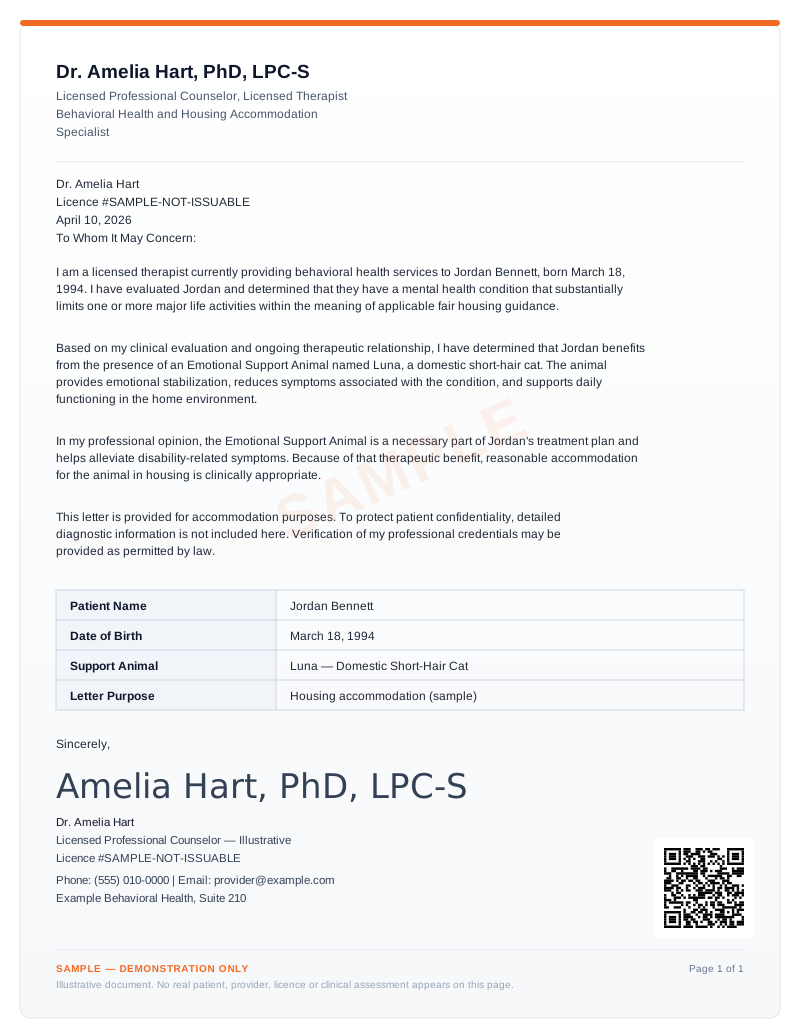
Each PawTenant letter carries a discreet verification QR code. Landlords can confirm authenticity without seeing any medical detail.
Who May Qualify for an ESA Letter?
Eligibility is determined during the evaluation by a licensed mental health professional. Common DSM-5 conditions our network evaluates include:
Don't see your situation listed? Start your free assessment — eligibility is decided during the licensed evaluation, not before it.
How Online ESA Evaluations Actually Work
No magic instant approvals. Just a real, licensed clinical evaluation — done by telehealth.
Online Assessment
You complete a short questionnaire about your symptoms, daily functioning, and your interest in an emotional support animal. This is the intake — it does not approve or deny a letter on its own.
Telehealth Evaluation
A licensed mental health professional in your state reviews your intake and conducts a real one-on-one evaluation by video or phone. They decide whether an ESA may be supportive for your treatment plan.
Letter Issuance
If the licensed clinician determines that an ESA is appropriate, they issue a signed letter on official letterhead — including their license number, state, and signature — for housing accommodation requests.
Verification Support
If your housing provider asks to verify the letter, our team can support a privacy-safe license verification process — without exposing your medical information.

On the Call
- Licensed clinician licensed in your state
- Real one-on-one telehealth evaluation — no chatbot
- HIPAA-aware intake & encrypted records
5–10 minutes · Confidential · No charge for the assessment itself
Signs of a Legitimate Online ESA Letter Provider
These are the simple, practical signals that separate a real clinical service from a sketchy form-and-checkout site.
Real Licensed Clinician
The letter is signed by a real, state-licensed mental health professional — psychologist, therapist, LCSW, LPC, or psychiatrist — with a verifiable license number.
Actual Evaluation Took Place
There was a real telehealth visit (video or phone) where you spoke directly with the clinician. No legitimate letter is issued without one.
Letter on Official Letterhead
The letter appears on the clinician's letterhead with their name, credentials, contact information, and signature — not a generic template.
Recent and Dated
The letter is dated and remains current — typically within the last 12 months. Housing providers can reasonably request a recent letter.
Red Flags of Sketchy Online ESA Sites
If a site shows any of these, treat it as a strong warning. A letter from a sketchy site can fail when your housing provider scrutinizes it.
Instant or Same-Hour Approval Without an Evaluation
If a website promises a letter in minutes without a clinician speaking with you, that is not how legitimate ESA letters work — and a housing provider can challenge it.
Selling Registries, Certificates, or ID Cards
There is no official US ESA registry. Plastic ID cards, vests, and registry numbers do not confer legal protection — only a clinician's letter does.
No Information About the Clinician
Legitimate services name the clinician, their credentials, and their license number on the letter. If you can't see who is signing, that is a red flag.
100% Approval Guarantees
No legitimate clinician can guarantee approval before evaluating you. Approval depends on a real clinical assessment of your situation.
High-Pressure Upsells
Be cautious of sites that aggressively upsell vests, certifications, or premium tiers that have no legal weight. The letter itself is what matters.
Promises of Public Access for an ESA
ESA letters are mainly for housing. Any site promising restaurant, store, or full airline access for an ESA is misleading — that is service-dog territory.
Plain rule: if a site does not put a real licensed clinician on a real call with you, it is not a real ESA letter service. PawTenant's network is built around licensed mental health professionals — see our process below.
ESA Letters and Housing Accommodation
ESA letters are primarily relevant in the housing context. They support a written request for a reasonable accommodation under the Fair Housing Act, which addresses how housing providers handle requests from tenants with disability-related needs.
Housing providers typically may ask for documentation that there is a disability-related need for the animal. They generally are not expected to demand specific medical records or particular diagnostic details. PawTenant supports privacy-safe verification of the licensed clinician's credentials when a housing provider asks to confirm the letter.
Fair Housing Act Coverage
Most rental housing in the US is covered by the Fair Housing Act, which addresses reasonable accommodation requests for emotional support animals.
Pet Fees and Deposits
An ESA is not classified as a pet for housing accommodation purposes. Pet fees and pet deposits typically do not apply once an accommodation request is granted.
What a Landlord May Ask
Housing providers may ask for documentation of the disability-related need but cannot demand medical records or specific diagnostic details.
Reasonable Accommodation, Not Automatic Approval
Accommodation requests are reviewed individually. PawTenant's letters are written to support a clean accommodation request, but final acceptance is up to your housing provider.
This page is informational and not a substitute for legal advice. Specific protections, exceptions, and procedures vary by state and by housing type.
Housing rules and ESA guidance vary by state
The Fair Housing Act applies nationwide, but a handful of states layer in their own statutes, waiting-period rules, or provider-licensing nuance. Start with the state where you live — each guide is reviewed for that state's accommodation context.
Privacy-Safe Letter Verification for Housing Providers
When a housing provider asks to confirm an ESA letter, they can verify the licensed clinician's credentials through our secure verification page — without seeing any of your medical information. The clinician's name, license number, state, and license status are surfaced; nothing more.
- Discreet verification QR code on every letter
- Provider license confirmed by state board
- No medical details ever disclosed
Letter Verified
Active accommodation document on file
Sample verification result
ESA-SAMPLE-0000
Example Provider
Sample licensed provider
Illustrative verification example — not a real provider or license.
No medical detail disclosed — license & status only
ESA Letter vs. PSD Letter — Which Do You Actually Need?
An ESA letter is mainly for housing. If your dog has been task-trained to perform specific actions related to a psychiatric disability — for example, interrupting panic episodes or grounding during dissociation — a Psychiatric Service Dog (PSD) letter may be more appropriate, with broader public-access considerations under the ADA.
Why People Choose PawTenant for Their Online ESA Letter
Built around licensed mental health professionals, real evaluations, and clean documentation that holds up to housing-provider scrutiny.
Only Licensed Mental Health Professionals
Every evaluation is conducted by a state-licensed clinician — never a chatbot or non-licensed staff.
HIPAA-Aware Process
Your intake answers and evaluation notes are handled in line with HIPAA standards. We do not sell your data.
24-Hour Turnaround
If you qualify after clinical review, your letter is typically delivered within 24 hours.
Annual Renewal Support
Renewing an existing ESA letter through PawTenant is straightforward when your situation continues year over year.
Verification Help for Housing Providers
If your landlord asks to verify the letter, we can support privacy-safe verification of the clinician's license — no medical details exposed.
No-Risk Guarantee
If you do not qualify after the evaluation, you do not pay for the letter. See our money-back details on the No Risk Guarantee page.

Your Animal Is Part of Your Daily Wellbeing
For many people, an emotional support animal is a quiet, steady part of getting through hard days — long before any housing question comes up. A legitimate ESA letter exists to make sure that support is not torn away by a no-pet policy.
That's why a real evaluation by a licensed mental health professional matters: the documentation you receive should reflect a real care relationship, not a checkout flow.
Ready to Start Your Online ESA Evaluation?
Begin with a free 5-minute assessment. A licensed mental health professional in your state will reach out to schedule a real telehealth evaluation — no instant-approval shortcuts.
Licensed Review
State-licensed clinicians only
Typically 24 Hours
After provider review, if you qualify
Money-Back
If you don't qualify, full refund
No commitment · Confidential · Eligibility decided during the evaluation