
ESA Laws & What a Valid ESA Letter Actually Requires
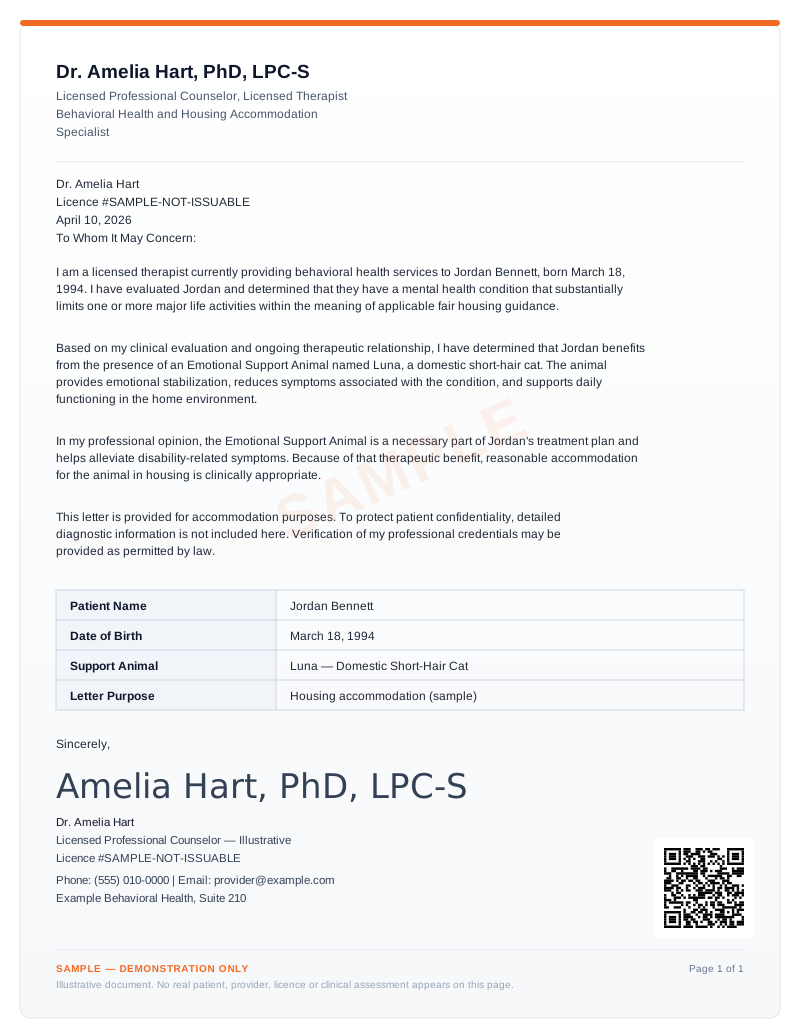
A clear, honest explanation of how emotional support animals are protected under the federal Fair Housing Act — what a legitimate ESA letter needs, what it can do, and what it cannot do.
Start for as low as $32.25
A licensed provider decides whether an ESA is clinically appropriate — approval is never guaranteed.
Sample ESA letter — names & details are placeholders.

ESA law is really about keeping you and your animal at home together
Behind the statutes is a simple goal: letting people who rely on an emotional support animal keep that companion where they live. Here's what the law actually requires — in plain language.
- An ESA is treated as an assistance animal for housing, not an ordinary pet.
- A qualifying request can be honored even under a “no pets” policy.
- Pet fees and deposits generally don't apply to assistance animals.
How the Fair Housing Act protects ESA owners
The federal Fair Housing Act (42 U.S.C. § 3601 et seq.) requires most housing providers to make reasonable accommodations for people with disabilities. An emotional support animal is treated as an assistance animal — not a pet — when it helps alleviate one or more effects of a person’s disability.
That means a qualifying ESA may be allowed even where a building has a “no pets” policy, and pet fees or deposits generally should not apply. The accommodation is requested with documentation from a licensed provider, and each request is evaluated individually under the law.
What a legitimate ESA letter requires
A valid letter is the product of a real clinical process — not a quick download.
A licensed provider
The letter must be written and signed by a licensed mental health provider (such as an LMHP, LCSW, LPC, psychologist, or therapist) who is credentialed in the state where you live.
A real evaluation
The provider reviews your situation and uses clinical judgment to decide whether an emotional support animal is clinically appropriate for you. There is no automatic or guaranteed approval.
Proper documentation
A valid letter is on the provider's letterhead and typically lists their name, license type, license number, the state of licensure, and the signature and date.
A housing purpose
An ESA letter supports a reasonable accommodation request for housing. It is not a license, a registry entry, an ID card, or a certificate.
What an ESA letter can do
Support a reasonable accommodation request so a housing provider considers your emotional support animal even under a "no pets" policy.
Help you ask a landlord to waive pet fees or pet deposits for a qualifying assistance animal (many jurisdictions prohibit these for assistance animals).
Document, in writing from a licensed provider, that the animal is part of your support plan for a qualifying condition.
What an ESA letter cannot do
Guarantee that a housing provider will approve your request — accommodations are evaluated case by case under the law.
Give your animal public-access rights to restaurants, stores, hotels, or other businesses. That is the domain of trained service dogs under the ADA, not ESAs.
Require an airline to allow your ESA in the cabin for free. Since the 2021 DOT rule change, airlines generally treat ESAs as regular pets.
Replace a clinical evaluation. No website can "register" or "certify" an ESA in a way that carries legal weight.
Built on Four Pillars of Verification
Every letter we issue is grounded in licensed clinical practice, federal housing law, real telehealth evaluation, and a verifiable ID system landlords can check in seconds.
Licensed Mental Health Practitioners
Every letter is signed by a state-licensed clinician — LCSW, LMHC, LMFT, LPC, or psychologist — verified against the relevant state licensing board before they join our network.
- Active state license required
- Continuous license monitoring
- NPI number on every letter
Fair Housing Act Compliant
Our documentation is structured to meet the Fair Housing Act and HUD reasonable-accommodation guidance, so landlords have a clear, lawful basis to honor your request.
- FHA reasonable accommodation language
- Recognized by HUD guidance
- Used in all 50 states + DC
Telehealth Clinical Process
Every letter follows a genuine telehealth evaluation with a licensed clinician — never an auto-generated form. The provider's name and credentials appear on the document.
- Real video consultation
- HIPAA-secure platform
- Clinician-signed PDF
Portal ID verification
Each finalized order has a verification ID in the customer's portal. Landlords can enter it at pawtenant.com/verify to confirm authenticity — no diagnosis, no health information shared.
- Verification ID in the customer portal
- Instant landlord lookup
- Privacy-safe by design
No diagnosis, treatment notes, or personal health information are ever disclosed during verification.
ESA Letter Pricing
Clear, upfront pricing — from $115
Pay by card, or choose Klarna at checkout — subject to eligibility and Klarna payment terms. A licensed provider reviews your assessment — approval is not guaranteed.
One-time
Valid for 1 year. Pay once, no auto-renewal.
- Licensed provider review
- Money-back if not approved
- Verifiable, housing-ready letter
- Free Pet Care Planner by PawTenant
Annual
Renews automatically. Save vs. one-time every year.
- Licensed provider review
- Money-back if not approved
- Verifiable, housing-ready letter
- Free Pet Care Planner by PawTenant
PawTenant also supports PSD (Psychiatric Service Dog) evaluations for qualifying individuals where clinically appropriate. PSD documentation requires disability-related task training and is different from ESA documentation.
Landlord or HOA need a separate accommodation form? See ESA packages & Reasonable Accommodation pricing.
ESA laws & requirements FAQ
No. There is no official emotional support animal registry in the United States, and no certificate, ID card, or vest carries legal weight on its own. What matters for a housing accommodation request is a letter from a licensed mental health provider based on a real evaluation. Be cautious of any site selling instant "registration" or "certification."
State-specific ESA rules
Several states layer extra rules on top of the federal baseline. Read the guide for your state:
Sources & references
- Fair Housing Act — 42 U.S.C. § 3601 et seq.
- U.S. Department of Housing and Urban Development (HUD), Assistance Animals program information — hud.gov
- U.S. Department of Transportation, Air Carrier Access Act final rule on traveling by air with service animals (effective 2021)
- California Health & Safety Code § 122318 (AB 468); Florida Statute § 760.27; Iowa Code § 216.8B and Senate File 2268 (2024)
This page is for general information only and is not legal advice. Laws change and vary by state and housing type. Whether an ESA is clinically appropriate is determined by a licensed provider’s evaluation. For advice about your situation, consult a qualified attorney or your local fair-housing agency.
Ready to start your evaluation?
Connect with a licensed provider who will review your needs honestly.
Begin Your ESA AssessmentSupport animal housing rules changed in 2026
HUD's federal enforcement approach changed, but state law, housing type, Section 504, private legal rights, and individual facts may still matter. PawTenant helps customers understand their options through licensed, state-aware support-animal documentation — issued only when clinically appropriate.
Educational information only — not legal advice. PawTenant does not certify or train service animals, and approval depends on your housing provider, state law, housing type, and individual facts.